
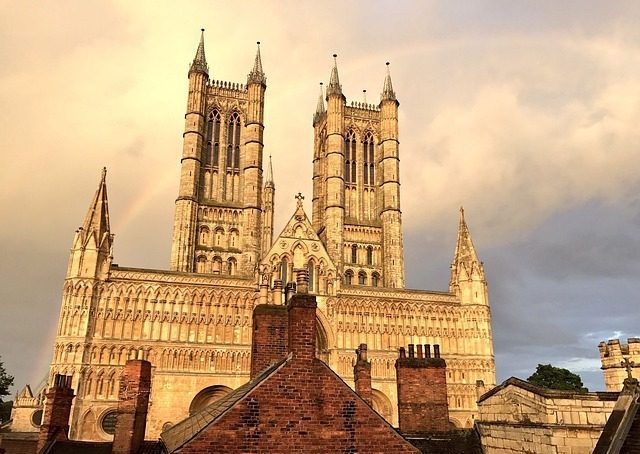
The first thing that struck me in Lincoln was the crisp morning air, scented faintly with wood smoke and fresh bread, as cathedral bells chimed softly in the distance. I recently took a day trip to Lincoln from London with my husband and was really impressed.
Lincoln is a hidden gem in England. The city is small enough to explore in two or three hours, not counting the museums, but it is packed with sights and atmosphere that can rival York.
Lincoln’s medieval buildings, winding cobblestone streets, and old houses on Steep Hill make it feel like you’ve stepped into a British period drama.
It’s easy to imagine Lincoln as a setting for a Harry Potter film, with crooked shopfronts that look like Diagon Alley and cathedral cloisters that remind you of Hogwarts.
As my husband and I paused on a cobbled corner, the chilly air turning our breath to mist, the sight of gas lamps flickering above higgledy-piggledy streets truly made us feel as if we were extras on a period drama set. The nearby moors could even pass for the dramatic landscape in Wuthering Heights.


Quick Links
How to Reach Lincoln from London
If you are going from London, you can visit Lincoln by car or by train.
By Car
My husband and I did a road trip from London, and it took us three hours to reach Lincoln, including a half-hour stop for breakfast at South Mimms Services on the M25.
We parked our car at NCP Lincoln Central, which was expensive: we paid £9.80 for 4 hours via the ParkPass app.
By Train
You can take the LNER to Lincoln from King’s Cross station, which takes almost 2 hours.
For Roaming Around
Lincoln is charming for a long stroll, but if anyone has mobility issues, take the Steep Hill Shuttle bus to get around; it is the fastest way up the hill and has 13 stops across the city. Some of Lincoln’s main attractions, such as the castle grounds and the cathedral, have accessible entrances and facilities; other historic buildings may have limited step-free access in certain areas.
It’s a good idea to check the latest accessibility information on each site’s official website before your visit.
The Perfect 1-Day Lincoln Itinerary for Couples
Lincoln has 2000 years of Norman, Roman, Viking and English history stacked vertically on top of each other. The Roman heritage in the modern city of Lincoln is clearly visible, as it was built on the site of the ancient colony of Lindum Colonia.
Perched on a Limestone cliff overlooking the fens of the Eastern Midlands, Lincoln has an “upper city” (the original fortress on the Uphill) and a “lower city” (the later, stretching towards the river) as part of the Roman defence system.
The best way to see Lincoln is to follow a loose trail that links its upper and lower halves. To help you plan your own adventure, we chose a top-to-bottom approach (North to South) because it let us catch the main attractions—like the cathedral, castle, and museums—as soon as they opened, making the most of our morning energy and the quieter early hours.

You can also choose a bottom-to-top approach, depending on your priorities. Let your curiosity guide you. We started at the top, fueled by a hearty breakfast, eager to catch all the time-sensitive sights first—the cathedral, the castle, and the museums.
My advice: For the most romantic atmosphere, consider visiting in spring or autumn when the city’s gardens are in bloom, or the golden leaves on Steep Hill create a magical backdrop. During these seasons, the weather is usually pleasant for strolling, and you’ll find fewer crowds than in the summer or during major events.
Fun Things to Do in Lincoln for Couples
This section is also a part of Lincoln’s 1-day itinerary. Most of the places I am going to list here are free to visit, either entirely or partially.
Temple Gardens
From our car park, we walked towards Temple Gardens on Danes Terrace, a part of Lincoln’s Cultural Quarter, where you can enjoy the sculpture art without paying an entry fee. Joseph Moore established it in the early nineteenth century, and the artworks in the garden were displayed through paid entry at that time.
Temple Gardens was reopened as a public space, along with The Collection and Usher Gallery, in 1927. While sitting on a bench in this garden, you get a glimpse of the Medieval Bishop’s Palace ruins and Lincoln Cathedral in backdrop. This garden was named after the temple built in its north.
Lincoln Museum
Earlier, the Lincoln Museum was known as The Collection Museum, but Lincolnshire County Council changed it to ‘Lincoln Museum’ from 1st April 2023 to make visitors aware of the museum’s purpose. Lincoln Museum has been closed since October 2024 for redevelopment work, but the Usher Gallery is open for visitors.
Lincoln Museum displays the history and archaeology of Lincolnshire from the Iron Age, along with a stunning art and treasures collection at the Usher Gallery. Admission is free except for events. It opens from Thursday to Monday, 10 am to 4 pm.
Newport Roman Arch
From Lincoln Museum, we wandered through the cobbled twists of Steep Hill, crossed the bustle of Castle Square/Historic Cathedral Quarter, and arrived at our first landmark: the ancient Newport Roman Arch, a proud remnant of Lincoln’s Roman Fourth Wall.
The Newport Roman Arch, built in 200 AD, is the oldest archway in the UK still welcoming traffic after 1,800 years. Its sturdy stones showcase Roman engineering at its finest, with a smaller archway inviting pedestrians to step back in time.
This arch served as the North gateway to the Roman settlement of Lindum Colonia, and today it is one of Britain’s most popular monuments.
The history of Lincoln dates back to Roman times, leaving behind structures still in active use today, such as Newport Arch.

The house against the gate has been built many times since 1717.
Museum of Lincolnshire Life
This museum is a must-visit if you are keen to learn about Lincolnshire culture from the 18th century to the current day. The exhibits in the museum depict domestic, agricultural, industrial and community life. The museum is open in an old Victorian barrack on Burton Road, built for the Royal North Lincoln Militia in 1857.
Inside, you’ll discover a treasure trove of 250,000 artefacts, from gleaming vintage cars to mighty steam locomotives. The glory of this museum is Daphne, a World War I tank that proudly recalls Lincoln’s legacy as the birthplace of the military tank.

Step into recreated Victorian shops and cosy domestic rooms to get transported into the daily lives of Lincoln’s past residents.
Entry is free, except for special events, and there is also a history trail and a playground for children. You can visit from Tuesday to Friday, 10 am to 4 pm. The museum staff also run group quiz sessions and a school program based on the National Curriculum.
If you want a quick tea break, visit The Gatehouse Tearoom for refreshments.
Ellis Mill
Hidden behind the Museum of Lincolnshire Life on Mill Road, an 18th-century Grade II flour mill still turns its sails, reminiscent of the iconic windmills of Zaanse Schans in the Netherlands.
Once one of nine windmills gracing Lincoln’s Uphill skyline, this mill is the last one standing. After a devastating fire in 1974, Lincolnshire County Council lovingly brought it back to life in 1981.
We missed our chance to peek inside, but you might be lucky, as Ellis Mill sometimes opens its doors around noon on weekends, especially in the blossoming month of May. Entry to the mill floor is free.
Since opening times can change due to weather, maintenance, or special events, it is a good idea to check the latest schedule before your visit. You can do this by visiting the local tourism website or calling ahead to confirm opening hours. This way, you can make the most of your trip and avoid disappointment.
Lincoln Castle & Magna Carta
Next in the Historic Quarter, we went to Lincoln Castle. Lincoln Castle, a fortress steeped in centuries of drama, from its Norman origins to its English heritage.
When Normand invaded Britain, William the Conqueror chose this strategic site, a former Roman fortress, to build Lincoln Castle (1068) and the cathedral (1072) as clear messages proclaiming his power and dominance over the new Anglo-Danish population.
William the Conqueror was a Norman king who also commissioned architect Gundulf of Rochester to build the Tower of London in 1078.
Lincoln Castle is the only place where the authentic 1215 Magna Carta and the 1217 Charter of the Forest can be seen adjacent. The Magna Carta is a foundational document limiting the monarch’s power under the rule of law.
On 15 June 1215, King John of England met barons and sealed the Magna Carta (“Great Charter”) at Runnymede to resolve a rebellion. It established rights such as protection against illegal imprisonment, access to justice, and liberties for the Church.
The documents were circulated to sheriffs, cathedrals, and important religious houses throughout England. As the Bishop of Lincoln, Hugh of Wells, who was also present at Runnymede, made sure that he sent a copy to Lincoln, where it remains to this day.
In 1217, Magna Carta was reissued as the Charter of the Forest to protect the rights of people living in royal forests, retaining some of its original clauses.
Only four original 1215 copies exist: two at the British Library (one damaged by fire), one at Lincoln Castle, displayed in a high-tech vault, and one at Salisbury Cathedral.
In the surroundings of David P J Ross Magna Carta vault, you will also see a stunning Great Charter Wall and Barons’ Shields.
You can wander the castle grounds for free, but to experience the breathtaking views from the Medieval Wall Walk, or to explore the Victorian Prison and Magna Carta Vault, you will need to purchase a ticket. Inside the Victorian Prison, there was a ‘Separate System’ to keep prisoners isolated from each other.
The ticket counter is at East Gate, and the ticket price is £12 for adults. The walls are closed for maintenance (at the time of writing this article). From April to October, the timings will be 10 am-5 pm, Monday to Sunday.
As you circle the castle walls, you will walk in the footsteps of kings, soldiers, and prisoners from centuries past. Dungeons and towers seem to murmur tales of fierce battles, dramatic sieges, and public hangings.


Lincoln Cathedral
On the opposite side of Lincoln Castle is Lincoln Cathedral or Lincoln Minster. Lincoln Cathedral is recognised as one of the finest examples of Gothic architecture in Europe. Victorian writer John Ruskin described the cathedral as a precious piece of architecture in the British Isles.
The stonework in the cathedral is full of complex carvings, and the intricate stained glass windows were once described as the “finest in the kingdom”.
It held the record as the tallest building in the world, overtaking the Great Pyramid of Gaza for over two centuries, after a spire was added to a new tower in 1311, replacing the original Central Tower, only to collapse in a raging storm in 1549.
Lincoln Cathedral also had the surviving copy of the original Magna Carta, which it later loaned permanently to Lincoln Castle.
The cathedral is full of hidden treasures: spot the Lincoln Imp, a mischievous stone gargoyle said to have been sent to cause chaos; a tiny, friendly lion carving; graffiti of a sailing ship; the Christopher Wren Library brimming with 15th-century books above the cloisters; the Chapter House, which starred in The Da Vinci Code; the Galilee Porch; and the ethereal Angel Choir.


Be sure to wander the cathedral grounds and The Dean’s Green, a serene and beautiful garden just outside Lincoln Cathedral that welcomes visitors free of charge. If there’s one moment I will always remember about Lincoln, it was sitting side by side with my husband in the quiet garden behind Lincoln Cathedral, just as the afternoon light streamed through the ancient stone arches with the dulcet sounds of distant bells in the air. We shared laughs about my enjoyable struggle up Steep Hill, which added another special moment to our trip.
If this is your first time at Lincoln Cathedral, book a tour to learn the secrets of the Minster Yard, historic graffiti, stories hidden in the stained glass windows, the history of its iconic architecture, and the hidden meaning of its stone carvings. Additionally, you can take the cathedral’s Central Tower and roof tour to enjoy 360-degree views of Lincoln city. Here is a link to book a guided tour of Lincoln Cathedral.
The cathedral’s opening times are 1 am to 4 pm Monday to Saturday, and 11:30 am to 2:30 pm on Sunday. Admission prices are £10.95 for adults on Sunday and £12.95 from Monday to Saturday. Entry is free for UK students.
Steep Hill
The Steep Hill was crowned Britain’s Great Street in 2012. It is so steep that handrails had to be installed to help visitors conquer its dramatic incline.
Steep Hill in Lincoln is a historic, 16.12º gradient, cobbled street that connects The Strait to Castle Hill/Historic Cathedral Quarter. It first came into use when Lincoln was Lindum Colonia, and the Roman residents decided to expand down the hill.


According to the Ordnance Survey, it’s the fourth steepest street in England. Along the way, you will find quirky shops, charming tea rooms, and antique stores like The Mouse House and Cahoots, plus historic gems such as the 12th-century Norman House with its double-arched windows, Jews’ Court, and the delightfully crooked “Wonky House” on Michaelgate.

Since it is a challenging walk, you can take the “Walk and Ride” shuttle bus service for a less strenuous route. The shuttle is wheelchair accessible, making it a helpful option for travellers with mobility issues.

Jews’ House
It is one of the oldest domestic houses in England, now a restaurant at the base of Steep Hill. The building is one of only five surviving Medieval Jewish houses in England, evidence of the well-known Jewish community in Lincoln during the 12th and 13th centuries.

In January 2009, the Jews’ House suffered a serious fire, but it has since been beautifully restored. While I didn’t venture inside, I came across a local news story hinting that its shadowy, blood-stained history still haunts its walls.
The jews gathered at this building in a wedding were accused of murdering a Christian boy. Additionally, English people captured the house from its owners due to the ‘Edict of Expulsion’, issued by King Edward I, because of the country’s conflict over usury (the lending of money with interest, which Christians were not allowed to do).
Take a tea break at Bells Tea Shop
If you find yourself weary from the climb, treat yourself to a break at Bells Tea Shop, nestled in a charming timber-framed building at 38-39 Steep Hill. Their traditional afternoon tea is a delight, and well worth the £16 splurge.

To make the moment more memorable, I suggest turning your visit into a little ritual: while sharing warm scones and tea, take a pause to tell your partner the highlight of your day so far. It’s a simple gesture, but it transforms the tea break into a romantic anchor—one you’ll remember long after your visit.


Guildhall and Stonebow
Next, we wandered down from the Strait to Stonebow, a striking limestone arch. In Roman times, this gateway marked the city’s southern entrance; it was later renamed Stonebow after the Viking invasion in the late 8th century. Today, it stands as a dramatic highlight of Lincoln’s High Street.
The entrance gate to Guildhall was closed, so we enjoyed the view of this Grade I listed building from the High Street. You can visit the Guildhall only through guided tours.

The Guildhall and Stonebow have been the place to host council meetings and the City Council events since the medieval period.
The Guildhall has many treasures, including the sword of Richard II and Royal Charters.
Guided tours take place on Monday, Wednesday, Friday, and Saturday at 10.30 am and 2 pm (April to October), and on Friday and Saturday at 10.30 am and 2 pm (November to March). Book them in advance by calling 01522 873303 or emailing civic@lincoln.gov.uk.
High Bridge
High Bridge is the oldest bridge in England still supporting houses, and it boasts a distinctive 16th-century timber-framed tea room perched above the River Witham.
High Bridge is a medieval relic near the bottom of High Street. It was built in 1160 to replace an earlier Roman ford. The narrow opening created by the arch of High Bridge is called Glory Hole, which sets a limit on the size of boats.
In medieval times, the bridge’s narrow opening was grimly known as Murder Hole, where bodies tossed into the Witham would come to rest. For a different perspective, take the steps beside the bridge down to the riverside walkway and admire the arch from below.


Here’s a fun fact: while High Bridge’s current look is medieval, it was the Romans who first engineered this crossing and widened the river into the Brayford Pool, creating an inland port. Now you know!
St. Mary Le Wigford Church
St. Mary Le Wigford is Lincoln’s oldest church, with Saxon roots stretching back to the tenth century—something you can see in its ancient stones. The church is a living tapestry, pieced together with fragments from long-lost churches.
Wigford Church has never taken a break from its service, and was one of just two churches to remain open after the devastation of the 1644 Siege of Lincoln.

When we visited, the church was closed, so I captured a few pictures of the exterior. Opening and closing times are not mentioned on their website as of now.
Google Map Guide for Lincoln

If You Have Only a Few Hours to Explore Lincoln
My advice: Take your time and savour each stop. There’s no need to see everything in one go—We really had to rush to fit it all in a single visit. Our secret is that a few spots were closed, and then we spent less time at others.
If you only have a few hours, I recommend prioritising the most romantic highlights. Lincoln Cathedral is breathtaking and perfect for a quiet moment together amid its soaring arches and stained-glass windows.
Steep Hill offers a picturesque walk hand in hand, with cosy tea rooms like Bells Tea Shop for a shared treat.
Finally, take a stroll through High Street, where the views of Lincoln Cathedral create a dreamy backdrop for couples’ photos. Even if your time is limited, these three stops will make your day in Lincoln memorable and special.
Romantic Places to Stay in Lincoln
If you have the chance to linger longer in Lincoln, consider treating yourselves to a night at one of the city’s romantic accommodations.
Staying overnight offers the chance to enjoy Lincoln’s enchanting atmosphere after dark, when the cathedral is beautifully illuminated, and the cobbled streets feel especially magical.
Two standout options for couples are the White Hart Hotel, which offers elegant rooms and breathtaking rooftop views of the cathedral, and The Old Palace Lodge, where you can sleep within the walls of a restored historic building surrounded by tranquil gardens. There are also charming boutique guesthouses tucked along Steep Hill and in hidden courtyards, perfect for a cosy, memorable stay.
If you are staying for more than a day, here are more places to visit in Lincoln:
Medieval Bishop’s Palace: It’s a medieval palace in the heart of Lincoln, currently closed for renovation. It was damaged during the Civil War and later abandoned.
Metheringham Airfield Visitor Centre: Located about 12 miles south of Lincoln, the centre is a poignant, volunteer-run museum dedicated to the memory of 106 Squadron of RAF Bomber Command.
The Scoley family, owners of 600 acres of land that was used as an airfield, restored an original wartime ration store and gymnasium, transforming it into the Metheringham Airfield Visitor Centre in 1994, recognising the site’s historical importance. Today, the centre is run by a registered charity, The Friends of Metheringham Airfield, which continues to expand the collection and maintain the site with a team of dedicated volunteers.
The centre offers a remarkably personal look at life on a 1940s operational base. The standout exhibit is the Douglas Dakota KG651, which you can actually board to sit in the cockpit and experience the pilot’s-eye view. Open from the last weekend in March through the last weekend in October. Typically open Wednesdays (11 am – 4 pm) and Weekends/Bank Holidays (11 am – 5 pm).
Woodhall Spa is an elegant Edwardian resort village, often called the “Jewel in the Crown” of Lincolnshire. With its broad, tree-lined avenues and quirky independent shops, it offers a refreshing contrast to Lincoln’s medieval maze.
Tattershall Castle: It is a magnificent 15th-century red-brick tower that once served as a powerful medieval statement, rising 100 feet above the Lincolnshire fens. Tattershall Castle was built by Lord Cromwell, the Treasurer of England, and features opulent fireplaces and a rare double moat designed more for social status than for actual military defence.
Where to Eat Vegetarian Food in Lincoln?
Thailand No. 1: We had Thai food for lunch and loved the taste and price. This restaurant is at the top of the hill at 80-81 Bailgate.


Cafe Shanti is a city-centre favourite, famous for its quirky decor and a fully vegan menu that fuses Nepalese and British flavours.
Slow Rise serves up vegetarian Neapolitan-style pizzas, crafted with long-fermented dough and the freshest, highest-quality ingredients.
Pho Lincoln is a go-to spot for Vietnamese cuisine, offering a menu where a quarter of the dishes are meat-free, and a full vegan menu is available.
Make sure you check for reservations, especially on busy weekends.
Lesser-known Facts about Lincoln City
- During the Great War, Lincoln was known as “Tank Town” because the first-ever battle tanks, including “Little Willie,” were designed and built in the city by William Foster & Co.
- World’s Tallest Building: For 238 years (1311–1549 Lincoln Cathedral was the tallest building in the world, surpassing the Great Pyramid of Giza, holding the title until its central spire collapsed during a storm.
- The World’s First Barcode: Just outside the city in nearby Pinchbeck, the UK’s first-ever barcode was scanned in 1979 (on a packet of Melrose teabags). It marked the beginning of modern shopping as we know it.
- The Separate System: The chapel inside the Victorian Prison of Lincoln Castle features a “separate system” design with individual wooden booths, allowing prisoners to see the preacher while remaining in total isolation from one another.
- The Lincoln Imp: Visitors often search the stone carvings for this legendary, mischievous creature, which, according to local folklore, was turned to stone by an angel.
Movie facts about Lincoln
- For the 2023 epic Napoleon, Ridley Scott transformed Lincoln Cathedral into Notre Dame for Napoleon’s coronation. The city was flooded with hundreds of extras in 19th-century French military gear.
- Downton’s Prison Break: The Victorian Prison inside Lincoln Castle wasn’t just a museum; it was used as the filming location for York Prison in Downton Abbey Season 3 (where Mr Bates was held)
- A Netflix King: The 2019 Netflix film The King, starring Timothée Chalamet, filmed its grand coronation and interior palace scenes inside the Cathedral, utilising its massive Gothic nave to represent 15th-century France and England.
- A Royal Body Double: In the 2009 film The Young Victoria, Lincoln Cathedral stood in for Westminster Abbey for the coronation scenes. It looked so convincing that Princess Beatrice (who had a cameo) reportedly felt right at home.
All the images in the article are copyrighted by Traveltomuse.com
Which hidden corner of Lincoln will write the next chapter of your story? If you find yourself caught in a shower, don’t worry—Lincoln has plenty of cosy indoor spots to enjoy. Museums like the Museum of Lincolnshire Life and the Usher Gallery offer a warm and fascinating retreat, while tea rooms such as Bells Tea Shop make perfect hideaways for a rainy afternoon.
Check out my UK Travel Guide to explore more places in the United Kingdom.
No matter the weather, you will find romance and adventure around every corner. I would love to hear about your favourite discoveries and unforgettable moments, so please share them in the comments and inspire fellow travellers to explore this historic city.
Leave a Reply