
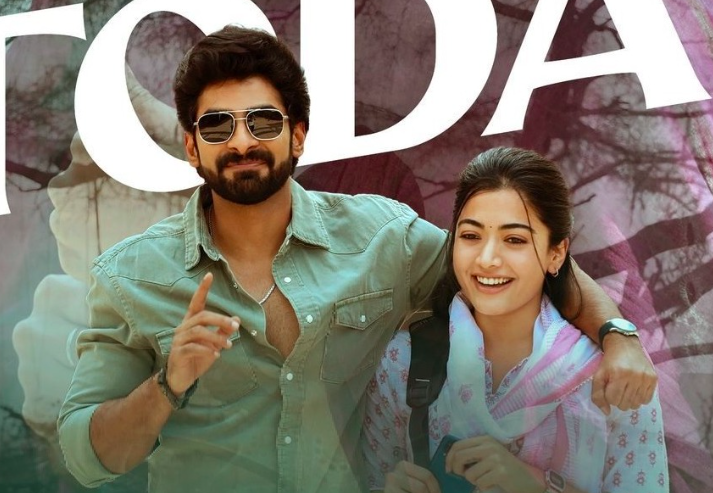
Is this movie relatable?
Disclaimer: This is not a movie review, which anyway doesn’t make sense after almost two months. The Girlfriend movie sparked a deep connection, about which I would like to discuss on this page.
Yesterday, I watched “The Girlfriend” on Netflix, featuring Rashmika Mandanna and Dheekshith Shetty. The story didn’t mirror my own life, but it echoed the experiences of someone dear to me. The ending felt far-fetched and left me unsatisfied, but I’ll circle back to that soon.
I read a Reddit thread where people were saying, “How can someone be so naive as to give control of their life to someone else?” But believe me, shit happens. Only those people can understand who have experienced such toxicity without even realising it.
Bhooma Devi moves to Hyderabad to study for an MA in English Literature. She finds comfort in books and is passionate about her dream of becoming a writer, which she shares in class on her first day of college.
After a few days, she meets Vikram, who is popular at college. Their first meeting takes place at night, when Bhooma and her friend accidentally hit a policeman’s car while riding an Activa the wrong way. As the man scolds them for being out late, Vikram and his friends step in and beat him up for not paying for the damage, not knowing he’s a policeman.
Consequently, the very next day, the police came into the college and took Vikram and one of his friends to the police station, and beat them brutally. His friends inform her friend Harshita and ask her to bring Bhooma to Vikram’s hostel room.
Harshita insists Bhooma drop her conversation with the professor midway and orders her to visit Vikram’s hostel room, while she herself heads off to class for a test. Honestly, Harshita flashes warning signs in Bhooma’s life even before Vikram does.
Vikram begins with a green-flag dialogue: the policeman had no right to talk to both of you harshly. Soon after, he gives a hint of his first red flag as a man-child when he says that Rashmika reminded him of his mother because she cared for him and did first aid.
It’s not wrong for him to get smitten by Bhooma’s care, but seeing similarities between Bhooma and his submissive mother was the first reason for his attraction to her. Since Bhooma grew up in a neglected childhood and held the responsibility of caring for her dad, she couldn’t recognise this red flag in the first place.
The friendship grows, and eventually, he invites Bhooma to watch her favourite movie, “Hi Daddy” with him in his room, intending to get intimate. His first kiss was without her consent, a second red flag, which she tried to stop hesitatingly, but he went forward.
The next day, when she saw the mirror, we, as an audience, sensed that she felt violated and wasn’t happy about it.
Before Bhooma can process things, Vikram tells everyone at college about their kiss. This is the third, and a serious red flag. Suddenly, everyone assumes they are a couple and that she is committed, all without her agreement, but she accepts the situation, and his happiness becomes her command.
While Vikram enjoys darts, archery, and other games with his friends, Bhooma is reduced to serving him food and handing him water in front of everyone, a role that echoes his mother’s.
In one scene, Bhooma wants to pay for her ticket, but he insists it is his responsibility and that he doesn’t want to be insulted in front of his friends.
She begins cleaning his hostel room to help him, and he becomes habituated to it.
Eventually, Vikram began isolating Bhooma from her friends, telling her that she didn’t need anyone because he was in her life. Vikram threatened Bhooma’s good friend Vinay to stay away from her after learning that Vinay liked Bhooma because of Harshita’s loud conversation, which Vikram overheard.
Vikram stopped giving Bhooma any space and began to stay with her day and night. The movie shows his hand around her neck and Bhooma’s dupatta as metaphors for entanglement. This sense of suffocation was like wearing a pair of shoes that were too tight; the constant pressure and lack of room to breathe mirrored her constricted life. That’s why in the farewell speech scene, she left her dupatta in her room as a sign of realising her freedom and self-worth.
Bhooma joins the theatre as an under confident actor, but finds Durga to be her rescuer. We all need a friend like her who can uplift us rather than push us down.
The play goes well, and everyone praises Bhooma’s performance, except Vikram. In fact, he disrespected her for doing it due to jealousy, male chauvinism and possessiveness. Bhooma feels sad about this, but she still can’t admit that her life is slipping out of her control.
The writer and director of this movie have also shown a remarkable difference between Durga and Harshita as friends. Harshita forced Bhooma to end her conversation with her professor even though there was no emergency, whereas Durga checked whether she had more classes before taking her out. This was the first time Bhooma could participate in games rather than just watch others play. At the end of the day, Durga pointed out that Vikram isn’t right for Bhooma.
Now, if you have seen this movie, you may think that Durga wanted to snatch Vikram from her as she tried to lure him into kissing her, to which he didn’t reciprocate (his only green flag character trait). However, that was before Durga and Bhooma became friends, about which she later confessed. Also, he didn’t get along with Bhooma because he didn’t see her as wife material and knew he couldn’t mistreat her.
Vikram even insults Bhooma in front of his friends for not informing him about going out, or maybe not taking his permission. It seems every chapter of Vikram and Bhooma’s relationship was open in front of his friends, and even the entire college.
The prominent eye-opener for Bhooma was the mirror at Vikram’s home, where she could see her transition from submissive girlfriend to a mute wife, just like Vikram’s mother, who never raises her eyes up.
His career matters, but Bhooma’s doesn’t, because she’ll need to handle home and babies in the future. At this point, Bhooma realised she was in a trap, but she didn’t know her way out, which the bathroom scenes explain articulately.
When Vikram asks his friends to guard Bhooma so she doesn’t go outside or her father doesn’t take her, it reminds me of the Eko movie, where the owner trained the dogs to protect his wife in the guise of control. The crux of the movie was “excessive protection becomes restriction,” and it easily applies here.
Besides Durga, another positive influence is Rahul Ravindran (the director) or Prof. Sudheer, who helps Bhooma see that she should take charge of her own life and decisions, rather than rely on her father or future husband.
When Bhooma tried to break up with Vikram, his first question was, “Did I ever hit you? ” as if he was doing a favour to her. Vikram has this compulsive habit of making a scene in front of others to take control of her.
Vikram can’t handle the rejection and tries to assault her in front of his friends and the whole college. He goes as far as strangling her, threatening her, and writing strange things on her door.
The irony is that Vikram behaves like a victim. He blames Bhooma for using him. He confesses to his friends for not giving enough time to them, even though he was the one who used to be around her all the time.
His line, “as long as I am alive, I will not let you be with anyone else,” shows the antithesis of the goodness in his character, but his friends are also blinded by his so-called virtue, or maybe they are like him, except one, who points out his stupidity.
His friend implies that Vikram doesn’t need Bhooma; he needs someone like her who can listen to his orders. He also needs only those friends who keep praising him. A sign of toxicity in friendships.
Bhooma’s father was another toxic person who never tried to understand her daughter’s feelings at all. What he saw in the hostel room wasn’t right, and any father would have been infuriated, but he never realised his mistakes, just like Vikram.
He never reflected on the fact that he should have taken care of Bhooma’s feelings in her mother’s absence, but he became the first example of a man-child to his daughter, leaving her naive and under confident.
Finally, the farewell speech, where Bhooma became Durga and fought her fears, but I wanted it to be a little longer.
I wanted Bhooma to say to Vikram, “I was never happy in this relationship. You forced yourself on me.”
If you ever cross my path again in life, you will have to bear the consequences. Now the entire college has seen your true character.
I wanted Bhooma to tell the whole college exactly what Vikram did to her—how he disrespected her, invaded her space, gaslighted her emotions, and the mental trauma she went through.
I wanted Bhooma to tell Vikram that he is not a victim of her rejection; rather, he is a victim of the patriarchy that he experienced during his childhood, which his mother never addressed because she was subdued by his father, and she is still in that trauma.
Now, about the ending. The final scene, where Bhooma talks to her father about booking his appointment, felt unrealistic to me. He never wanted her to study in a new city, called her characterless, and ignored her feelings since childhood. Suddenly, after she gets a job and becomes independent, he accepts her completely. In real life, people don’t change that quickly.
One more thing I would like to talk about, which movie makers hasn’t highlighted, is the importance of seeking professional help to overcome such trauma. Even Vikram needed counselling to work on his violent behaviour.
I’m not sure if this movie fully responds to films like Kabir Singh or Animal, but we do need more stories like this. Still, there should be a balance, which is why movies like “Pyar Ka Panchnama” should exist too.
Bottom line:
Green flags we all need in friends and mentors: Durga, Prof. Sudheer, and Vikram’s friend, who supported Bhooma.
Red flags: Harshita, Vikram, and his whole group.
Have you watched “The Girlfriend”? Did it make you uncomfortable?
PS: Hey readers! If you like my writings or you find my travel content useful, please support me.
PayPal account: traveltomuse@gmail.com
Leave a Reply