
Gravesend town is just a fifty-minute drive from London, and it’s situated in north-west Kent on the River Thames. Gravesend is very well connected to London via 20-minute trains to St Pancras International Station, or an Uber boat ride by Thames Clipper service. Gravesend is in the borough of Gravesham.
Astonishingly, I didn’t hear about Gravesend until I booked a staycation at a lakeside hotel in the area. Then at a party, my husband was discussing our weekend plan with his Indian friends, and one of them mentioned the Mohinder Singh Pujji statue in Gravesend. While doing research, I also learned about the Gravesend Gurdwara, the largest Gurdwara in Europe.
Gravesend is a small town, but it still has many stories to tell, from Pocahontas to Henry VIII, which I will be sharing with you, and this town also has a deep connection with Indians. So, keep reading until the end.
11 Things to Do in Gravesend
1. Stay at Inn at the Lake Hotel
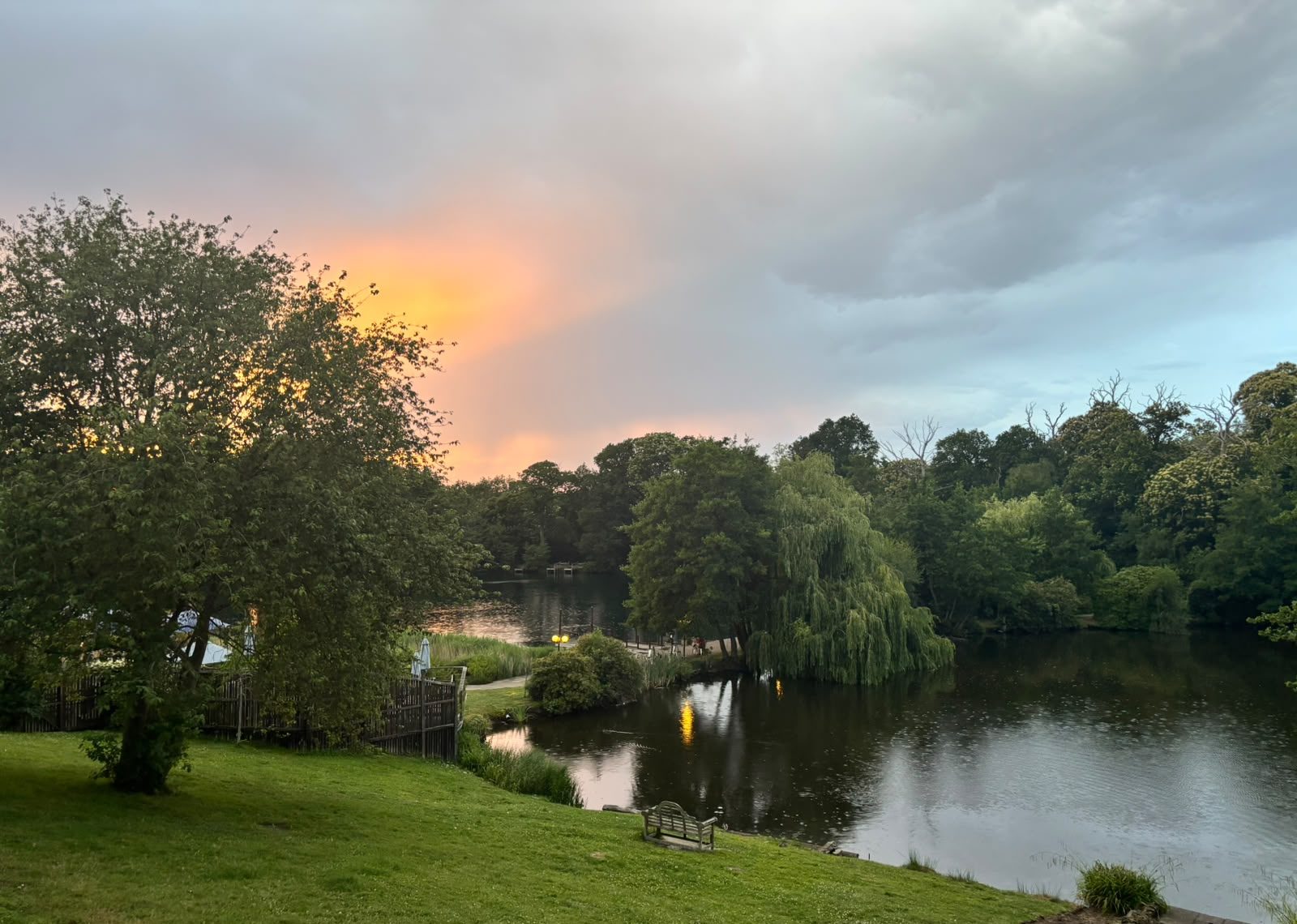
If you love to stay amidst nature, this place won’t disappoint you. This place could be a movie set where the trees, lakes, ducks and fish would play as characters. The most unbelievable thing was that I got a bridal room with a lakeside view at just 115 GBP.
When we arrived, I didn’t want to use my phone. I just wanted to get lost in the view, walk around, and soak up every second.
Though the temperature was high; it was pouring down, making our stay delightful.


2. High Street, Gravesend
After relaxing at the hotel, we went to the High Street to have tea or coffee. The cobbled-stoned High Street is full of independent shops, artisan makers and tea and tap rooms. While strolling on the High Street, we came across a small Indian tea room, Chaat and Chai Adda, and relished various snacks with Masala Tea. High Street is also the place where the grand Vaisakhi celebrations, the Fringe, and the Light and River Festival happen.

3. Gravesend Town Pier
From the High Street, we began walking to Gravesend Town Pier, which is currently under refurbishment. It is the oldest surviving cast iron pier in the world. William Tierney Clark designed it. While standing at the pier, you get wonderful views of the River Thames, which I enjoyed while standing at the car parking area beside the pier.
I heard from locals that there used to be a River Bar and Restaurant at the pier, which was also a great place to sit, relax, and enjoy the views.
4. Gravesend Blockhouse
Beneath the parking area, I noticed a D-shaped ruin, and when I read the story on the board, I learned that it was a Tudor fort built by Henry VIII.
This fort represents the first of five organised artillery defence networks for the River Thames to protect London. This Tudor fort worked in tandem with Tilbury Fort, which is across the river on the northern bank.
The fort was actively mobilised and repaired to deter high national threats, including the Dutch Navy’s raid in 1667 and the Spanish Armada in 1588. In 1844, the fort was demolished, marking it as redundant. This Tudor fort was forgotten until the archaeological excavations happened between 1975- 76, uncovering the buried foundations.
5. St. Andrew’s Gardens and Prominent Bronze Statues
Next, we visited St. Andrew’s Gardens — a riverside garden space located at a short walk from the pier, and it was also closed for restoration. We noticed a statue of a sardarji in the middle of the garden from the space between the grill, and when I zoomed in, I saw his name: Squadron Leader Mahinder Singh Pujji DFC. He was one of the first Indian Sikh pilots to volunteer to serve with the Royal Air Force during World War 2 in 1940, and he lived in Gravesend in his later years. This statue was built in 2014.
On the opposite side of the road, we saw another bronze statue of the late Queen Elizabeth II, which was unveiled in 2018. This statue of Queen Elizabeth II is noted as the only seated cast statue in the United Kingdom. Another interesting fact is that many local Indians monetarily contributed to the sculpting of this statue.

Douglas Jennings built both of these statues.
6. New Tavern Fort
While walking further, we reached New Tavern Fort—an 18th-century artillery fort built over Gordon Promenade. Gordon Promenade is a historic riverside walkway that evolved from an active military training ground into a Victorian pleasure park. Both the fort and the promenade represent the transformation of a highly fortified war zone into a peaceful, public leisure space.
Major Thomas Hyde Page designed the fort with a modern “bastion trace” system to defend the River Thames during the American War of Independence, when England faced threats. The fort remained active until the 20th century, and served in World War I and II. The military abandoned it in 1948, and the fort lay dormant until the 1970s. Then the local volunteers reformed it into a historic museum site. Entry is free.
7. Statue of Pocahontas and St. George’s Church
After completing our visit, we strolled back to High Street to have dinner at NH4 Cafe and Restaurant, which is on Bath Street beside St. George’s Church. To get to the restaurant, we came out of a narrow alley connected to High Street and saw St. George’s Church and the Statue of Pocahontas.
Before this, I had never heard about Pocahontas. She was also one of the tragic victims of colonisation. She was a native American, captured by colonists, kept in an English encampment and forcefully converted to Christianity before being brought to England. Pocahontas’ name was changed to Rebecca, and she was married to an Englishman, John Rolfe.
In 1616, her husband and the Virginia Company brought her to England to showcase her as a political symbol of a “peaceful and civilised American” to promote investment in the colonies.
While she was returning to her homeland, Virginia, she fell ill and was buried at St. George’s Church in Gravesend.
The bronze statue in the churchyard was a gift from America given by the Governor of Virginia.
8. Gravesend Gurdwara
The next day, we went to the Guru Nanak Darbar Gurdwara, the largest gurdwara in Europe. It was built in 2010 by the Sikh community in Gravesend. There are around 15000 Sikhs in Gravesend as of now, and the first migration for employment happened in 1950. This gurdwara was also shown in one or two Bollywood/Hindi language movies.
We took scarves available near the entrance gates to cover our heads, visited the main complex of the temple, and bowed our heads. While sitting there for some time, I felt calm. Then we took halwa prasad and went for Langar.
Places I didn’t visit, but can be a good addition to your itinerary
9. Gravesend Nuclear Bunker
The restored bunker is an underground command post located in Woodlands Park, DA11 7LF. It was designed to co-ordinate local rescue services during a nuclear attack in the Cold War. The bunker is a 13-room facility with 1950s equipment and a replica radiation monitoring post. It’s also the home to an air-dropped nuclear bomb. Visit the website for booking tickets. It’s normally open on Friday evening, and you must pre-book the tickets.
10. Saxon Shore Way
The Saxon Shore Way is a long-distance footpath in England. It starts at Gravesend, Kent, and traces the coast of South-East England as it was in Roman times as far as Hastings, East Sussex. The line of the Roman fortification that the route traces includes ancient forts, modern towns, nature reserves and coastline: four Roman forts built in the fourth century lie along the route, at Reculver, Richborough, Dover and Lympne.
11. The Lost Village of Dode
This Little Norman Building is a rare and magical place, looking almost exactly as it did over 900 years ago when it was built in the reign of William Rufus, the son of the Conqueror. As you stand beneath the massive stone arch, you stand where, over 800 years ago, a Priest told of the death of Thomas Becket.
The Village of Dode was destroyed in 1349 due to the Black Death, and shortly afterwards the building was abandoned. The building had been deserted for almost 150 years before Columbus discovered America. Indeed, it remained asleep until 1901, when it was purchased by a local antiquary who started to restore it at his own expense, but renovations stalled again due to the two world wars.
Restaurants and Cafes to Visit in Gravesend
- NH4 Cafe
- Chaat and Chai Adda
- Marie’s Tea Room
- Nell’s Cafe
- Harvester Gravesend
Leave a Reply